
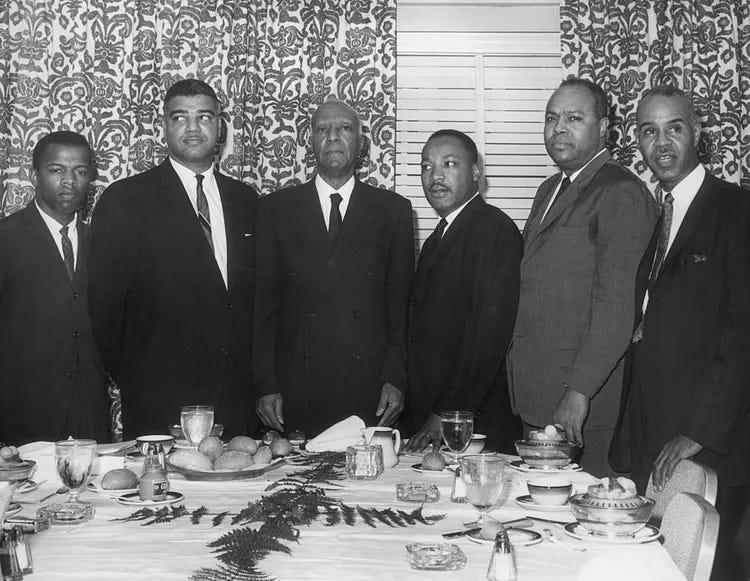
August 28, 1963. A quarter-million people gathered at the Lincoln Memorial for what should have been impossible.
Six major civil rights organizations - groups that competed for funding, argued over tactics, and fought for influence - put aside their differences for one day. The NAACP’s Roy Wilkins, who preferred litigation over protests. SNCC’s John Lewis, the young firebrand. Martin Luther King Jr. A. Philip Randolph, the elder statesman. James Farmer from CORE. Whitney Young from the Urban League.
They didn’t always like each other. They didn’t always agree. But they understood: their power came from standing together, not standing apart.
That unity created the largest demonstration for human rights in American history. It built pressure that led to the Civil Rights Act of 1964 and the Voting Rights Act of 1965.
The Pattern History Shows Us
The civil rights movement faced real internal tensions - the kind every movement faces when passionate people work toward ambitious goals under sustained pressure. Young activists thought established organizations moved too slowly. Established organizations worried about alienating allies. SNCC’s grassroots direct action clashed with the NAACP’s litigation strategy.
But something else was happening that most organizers didn’t know about until years later. The FBI’s COINTELPRO program took those natural stresses and amplified them at precisely the moments when people were most vulnerable to turning on each other. Anonymous letters accusing leaders of being informants. Infiltration spreading misinformation. Strategic pressure when tensions were already high.
By the mid-1960s, SNCC veteran Clayborne Carson observed staff cultivating skills for “organizational infighting” rather than “those that had enabled SNCC to inspire thousands of people outside the group during its years of greatest influence.”
Many organizations were weakened or dissolved - not because they were defeated from outside, but because internal stress consumed the energy that should have been directed toward change.
The question isn’t whether movements face internal stress. They do. The question is where that energy goes.
The Stress Test We’re Facing Now
Here’s the pattern that shows up in every movement that sustains long enough: organizations under prolonged stress start directing energy inward instead of toward their goals.
We’re watching this happen in real-time with the MAGA movement. Internal fractures. Influencers competing for attention. Local groups clashing with national priorities. Initial unified energy fragmenting into competing factions.
The same pattern is showing up in grassroots democracy defense movements right now.
You’re exhausted. You’ve been organizing at unsustainable pace. The wins feel small and the opposition feels massive. Volunteers burn out. Funding is precarious. Organizations compete for the same donor dollars, media attention, activist energy.
Under that pressure, energy flows in unproductive directions:
Competition replaces collaboration. Territory gets protected. Purity tests emerge. Egos clash. Resource anxiety drives decisions. Burnout becomes resentment.
All of it is understandable. All of it is human. All of it redirects energy away from November 2026 and toward internal conflict.
Where we direct that energy is a choice.
How We Channel Energy Toward What Matters
When movements direct energy inward - toward competition, ego, purity testing - they lose momentum regardless of whether anyone is actively working against them.
When movements direct energy outward - toward the shared goal - they build power that creates change.
Mutual aid between grassroots organizations is how we make that second choice. When an organization in Montana develops an incredible protest guide and shares it with organizations across the country, when a group in Colorado teaches their social media strategy to organizations in other states, when organizers facing legal harassment get immediate support from organizations they’ve never met - that’s energy flowing toward November 2026.
In practice, this means:
Share what works. Every organization using effective tools moves more energy toward the goal.
Amplify each other’s messages. Every share multiplies impact exponentially.
Offer expertise freely. Transform another organization’s capacity in a 30-minute conversation.
Build real relationships. When crisis hits, your energy stays focused on organizing instead of scrambling.
Create shared resources. Build once, share everywhere. The collective time saved is time spent on actual work.
Bridge ideological differences. You don’t have to agree on everything to work together toward November 2026. Different tactics, same goal.
Where We Go From Here
The stress won’t stop. The exhaustion won’t disappear. Organizations will keep facing pressures that cause energy to flow inward toward conflict.
But we get to choose where that energy goes.
When you’re tired, when you’re exhausted, when you’re feeling that pull toward frustration with other organizations - try this:
Take two minutes. Close your eyes. Take a deep breath.
Imagine it’s election night, November 2026. Let yourself feel what victory will feel like in that moment. The relief. The joy. The knowledge that you were part of turning the tide. The phone calls with other organizers celebrating what you built together. The recognition that democracy survived because enough people channeled their energy toward protecting it.
Now ask yourself: Is that moment worth doing what it takes in this moment to make that moment happen?
That feeling you just imagined - that’s what we’re building toward. That’s where the energy needs to go.
When we share resources instead of hoarding them, we’re building that victory. When we amplify another organization’s work instead of competing for attention, we’re creating collective power. When we offer help instead of judgment, we’re choosing sustained resistance that can actually reach November 2026.
The Choice Every Movement Faces
We’re at that same choice point the March on Washington organizers faced. Energy can flow inward - toward competition, ego, territorial protection, resentment. Or energy can flow toward the goal.
The March on Washington worked because they chose power over purity despite their differences, exhaustion, and legitimate disagreements.
The civil rights movement lost momentum when energy turned inward, when organizations spent more time on infighting than inspiring people.
We’re watching the MAGA movement fragment under its own internal stresses right now. They’re showing us what happens when ego and exhaustion become the focus instead of the goal.
We can learn from that pattern. Or we can repeat it.
November 2026 is ten months away. That’s time to register voters, mobilize communities, protect democracy, turn the tide.
Or it’s time to exhaust ourselves fighting each other while that opportunity passes.
The pattern is clear. The choice is ours.
A Request
Please take this article to the organizations you’re a member of. Use it as a catalyst for conversation about how you’ll proactively weather the months ahead, because the impacts of stress are only going to increase.
Talk about where your organization’s energy is flowing right now. Identify the patterns before they become problems. Create agreements about how you’ll support each other and other organizations when the exhaustion builds.
The stress is coming. The choice about where that energy goes - that’s what we can prepare for together.
Where will we focus our energy?
Democracy Spark provides ghostwriting for grassroots democracy organizations. You have the passion and vision, I have the words that move people to action. Let’s collaborate to bring our democracy back for the next generation.