
I woke up this morning to news in The Citizen’s Times that Asheville “may be a targeted city” for ICE and Border Patrol raids as early as this weekend.
My first thought wasn’t fear. It was: Oh, they really don’t know who they’re messing with.
Why We’re a Target (And Why That’s Actually a Compliment)
Let’s be honest about why we’re on someone’s list. It’s not because we’re weak. It’s because we’re everything that is a threat to authoritarian control.
We’re artists and organizers, mutual aid networks and community care. We’re weird and proud of it. We rebuilt after Helene by showing up for each other in ways that made national news for all the right reasons. We’re living proof that diverse, creative communities don’t just survive - they thrive.
They’re targeting the community that just proved we can organize under crisis conditions. And we’re still doing it. Just last week, The Orange Peel partnered with BeLoved Asheville to respond to SNAP benefit cuts caused by the federal shutdown. They’re turning every concert into a food drive and distributing EAT Cards to families because as they said: “We refuse to stand by.”
This is who we are. When crisis hits, we don’t wait for permission. We partner up, get creative, and take care of each other.
Walking and Chewing Gum
This is not just “one more thing” - it is all the same thing. Overwhelm is real. I get it. I’m still fighting for my healthcare. Still calling representatives about ACA premium tax credits. Still racing that December 15th deadline while worrying about federal agents showing up this weekend. And that’s exactly how resistance works. You don’t pick just one crisis. Because all these fights are the same fight - about whether we have power over our own lives or surrender that power to people who want to control us through fear. When we show up for immigrant neighbors, we’re showing up for healthcare, housing, every policy that says people matter more than power.
What Chicago and Portland Are Teaching Us
Other communities have been figuring out how to respond to exactly what might be coming our way.
And friends, they are showing the hell up.
Chicago: Where a Teenager Became the Resistance
In Chicago, a teenager named Ivan patrols his neighborhood every day. “I may not be no cop or none of that,” he told NPR, “but I be taking care of the community.” He watches for suspicious cars, gives people time to hide or flee, films what he sees. He’s not waiting for adults to fix this. He IS the resistance.
Chicago created something called Whistlemania - whistle kits with Know Your Rights pamphlets. Organizers expected maybe 15-20 people to show up and help assemble them. Four hundred came. They’ve distributed over 100,000 kits across the city. When you see ICE activity, blow your whistle. The sound brings community members out to witness, document, and make noise.
One woman in Mount Prospect ran outside when ICE showed up on her quiet block. She didn’t know exactly where she was going or what she’d do, but she’d watched videos of other people resisting. She said: “It was sort of like I was finally able to find a place to put my rage and try to be a little productive instead of feeling so helpless.”
Community resistance like this documented violations, created pressure, and supported the legal challenges that led to a federal judge ordering 615 people released, finding that the vast majority of arrests were unlawful. The resistance made that victory possible.
Portland: When the Resistance Got Weird
Portland looked at the same federal threat and said: “Hold my craft beer.”
It started with one person in a bright yellow chicken suit at the ICE facility. Then an inflatable frog appeared. Now there’s a frog colony, Stay Puft Marshmallow Man, dinosaurs, and my personal favorite, the Unipiper - a bagpiping unicyclist who wears a Darth Vader mask. Hundreds of nude cyclists staged an emergency naked bike ride protest. There was a wedding between two inflatable characters. Dance groups show up and do the Cha-Cha Slide in front of federal agents.
Why Being Weird Actually Works
The absurdity isn’t just fun - it’s strategically brilliant. L.M. Bogad, who teaches political performance at UC Davis, calls it creating “the irresistible image.” That’s an image so strange that even your opponents will broadcast it - and when they share it, they’re spreading your message.
Here’s what happened in Portland: Before they got weird, protests were “low energy, minimal activity” - people sitting in lawn chairs that nobody covered. After the inflatable frogs? International headlines. When federal officials tried to justify tear gas and flash-bangs, they had to explain why they were attacking dinosaurs and people doing the Cha-Cha Slide. The agents looked ridiculous. The narrative collapsed.
How does Fox News cover an inflatable frog colony without showing the frogs? How does the administration paint people doing the Cha-Cha Slide as “violent extremists”? They can’t. The absurdity itself is the defense.
But tactical frivolity does something even more important: It demonstrates confidence and power, not fear. Joy and creativity signal that we refuse to be controlled. Every inflatable costume, every dance party says: You wanted to terrorize us into submission. Instead, we’re having a party.
And it sustains resistance. Anger burns out. Joy and creativity can sustain resistance for months, years, as long as it takes. It also builds community - when you’re figuring out which costume to wear or learning the Cha-Cha Slide together, assembling whistle kits, you’re connecting with neighbors, creating the networks that sustain all the other work.
The weirdness isn’t silly. The weirdness is the weapon.
What This Means for Asheville
I cannot wait to see what Asheville’s response will look like, but I can feel the creative juices flowing already.
You’re artists and makers and musicians who’ve been creating your whole lives. You know exactly what Asheville looks like when Asheville shows up.
I was flipping through pictures I’ve taken of all the great gatherings we have. Shindig on the Green sparked a vision for me: federal agents in tactical gear facing down banjo players and clog dancers. That’s an image so impossibly Appalachian and joyful and unthreatening that every news outlet in the world will cover it. Try explaining to a national audience why you needed tactical gear for that. And when they do, they spread the message: This is what they’re afraid of?
Portland taught us that weird works. Asheville already knows how to be Asheville.
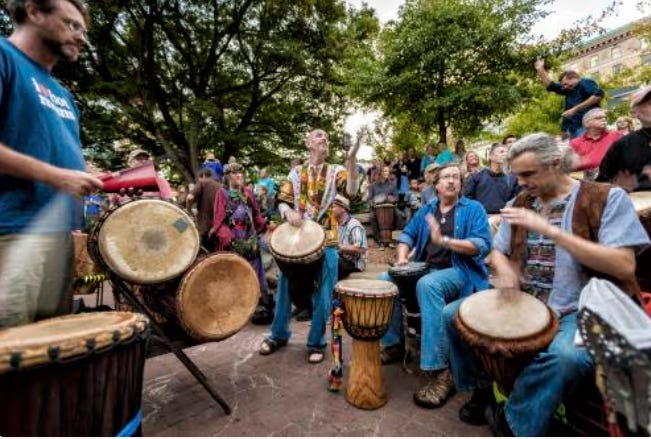
Different Roles, Same Resistance
If you’re a citizen who can witness and document, your role is to show up. If you’re undocumented or have family who is, your role might look different - staying safe, knowing your rights, having a plan. Not everyone can be on the front lines the same way, and that’s okay. Every role matters. The people who witness, the people who stay safe and prepared, the people who organize behind the scenes, the people who provide support - we all make the resistance work.
What You Can Do Right Now
Tonight, before you go to bed:
Search “Asheville Good Trouble” on Facebook and join the group. Search “Indivisible Asheville” or “Indivisible WNC.” These groups are already organizing.
Check Mobilize.us and search for Asheville. See what’s already being planned.
Text three neighbors you trust. Send them this post. Ask “Are you thinking about this too?”
If you’re an artist, musician, or performer, start a group chat tonight with other creative folks. Ask “What could Asheville’s response look like?”
Post in your neighborhood Facebook group or on Nextdoor: “I want to be part of Asheville’s response if ICE comes to our community. Who else is thinking about this?”
The most important thing is making sure we’re not organizing alone. Every conversation tonight, every connection you make, every group you join - that’s how the network builds.
Mobilize is where organizations coordinate. Facebook and Nextdoor are where neighbors find each other. Let’s get together and get weird.
Democracy Spark provides ghostwriting for grassroots democracy organizations. You have the passion and vision, I have the words that move people to action. Let’s collaborate to bring our democracy back for the next generation.