
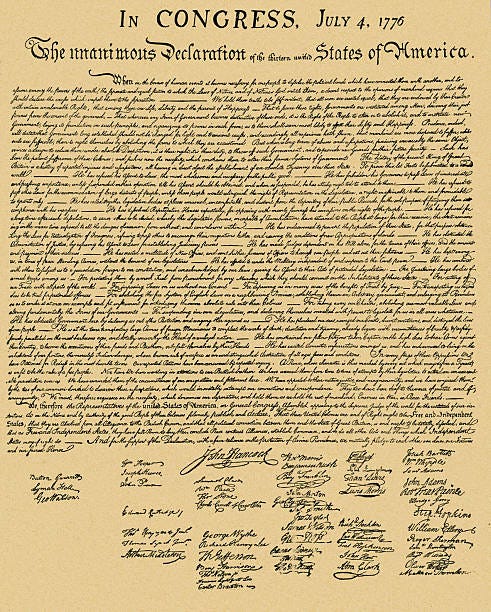
July 4, 1776 was not the founding of the United States of America.
It was a declaration of intent. Fifty-six men signed a document that could have gotten every one of them hanged, with no country behind them, the newly formed rag-tag Continental Army losing more than it was winning, and no guarantee that any of it would amount to anything at all. They were not recording a victory. They were making a bet.
The country they were declaring independence from was the most powerful military force on earth. The country they were declaring into existence did not yet exist.
What followed was not triumph. It was thirteen years of war, failure, argument, compromise, and hard reckoning about what this new thing would actually be. The Articles of Confederation came in 1781. The Constitution in 1789. The Bill of Rights in 1791. Fifteen years from declaration to the basic architecture of a functioning government — and even then, with slavery written into its bones and women invisible in its text. The declaration was the easy part. The easy part nearly killed them.
The founding was not a moment. It was a process. Bloody, contested, and unfinished. Only romantic in hindsight.
We call it an idea. But it has never been just an idea. Ideas can sit on a shelf. Ideas can wait. What the declaration called into being is alive — it breathes, it falters, it demands to be fed. It has survived wars and depressions and the long machinery of oppression because people in every generation chose to tend it. Not because it was guaranteed to survive. Because they decided it was worth saving.
A living thing that goes untended does not pause. It dies.
The resistance happening right now in this country is not a departure from the American story. It is the American story that every generation recommits to in their own time. What the declaration actually called into being — not a finished nation, but an ongoing argument about whether its promises can be kept. That argument has never been settled, only cycles of complacency and reawakening. Every generation has had to take it up again.
This one is taking it up in courtrooms and in the streets. In newsletters and in community meetings. In people who keep showing up after losses that would have justified stopping, who keep building infrastructure for a country they are not sure they will recognize by the time they are done. In the stubborn, unglamorous, frequently thankless work of people who decided that staying silent was worse than the alternative.
That is what we actually celebrate on July 4th. Not the date on the document. The bet those fifty-six men made — uncertain, unfinished, costly, and chosen anyway.
Two hundred and fifty years later, the spirit is alive and it is being tended in communities across the country. In this 250th year people have been put in camps where cruelty is the point, families separated, protesters shot and killed, resisters shot with chemicals — even faith ministers, healthcare cuts have killed people, and citizens are going to bed hungry. We focus on algae because it is an attack on what we went through to get here. All this and we are still showing up. I hope this is more than a moment of gathering with neighbors, I hope it is community building for even stronger resolve. And my ultimate hope is that this moment too becomes romantic in hindsight.
Democracy Spark provides ghostwriting for grassroots democracy organizations. You have the passion and vision, I have the words that move people to action. Let’s collaborate to bring our democracy back for the next generation.