
I’ve watched CBS Sunday Morning for years. It’s a program I love — unhurried, beautifully produced, a Sunday ritual. I noticed something shift after David Ellison took ownership, but I kept watching.
This morning I understood what had changed.
This morning, CBS Sunday Morning acknowledged the largest protest in American history in the transition between their introduction and a commercial break. Two static photo pages. Crowds in cities across the country, reduced to small frames. The chyron: Thousands took to streets in cities nationwide Saturday for “No Kings” demonstrations protesting President Donald Trump and his administration. A second frame noted that Bruce Springsteen performed in St. Paul. Associated Press photos throughout.
Eleven seconds. Thousands, not millions.
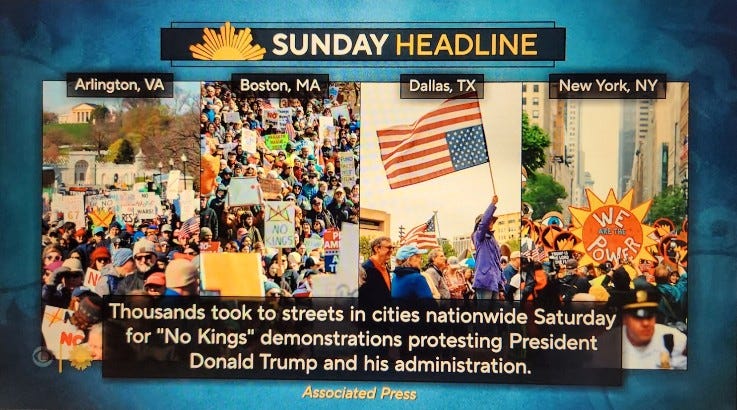
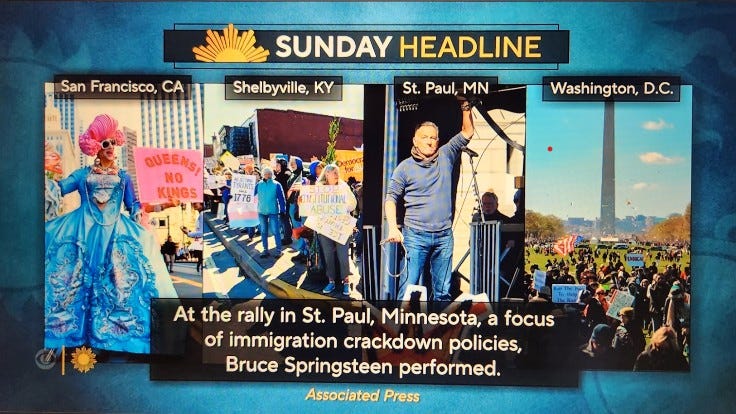
The No Kings Rally wasn’t a surprise to anyone. It was announced in January, called in the names of Alex Pretti and Renée Good — two Americans killed by ICE — and everyone with a calendar knew March 28th was coming. The organizers knew. The networks knew. The White House knew. Millions of people made plans, bought bus tickets, arranged childcare, and showed up.
What they showed up to was historic by any measure. More than 3,300 protests took place on March 28, 2026 — across all 50 states and more than a dozen countries. Not a demonstration. Not a rally. A simultaneous global movement moment, the third and largest wave of No Kings protests, the largest demonstration in American history. While a president sitting at 36% approval spent the day at Mar-a-Lago, protesters gathered outside his gates. They didn’t go to a symbol. They went to where he actually was. And they stood there and made themselves impossible to ignore.
CBS ignored them anyway.
I want you to look at what millions actually looked like. This is what millions looks like.
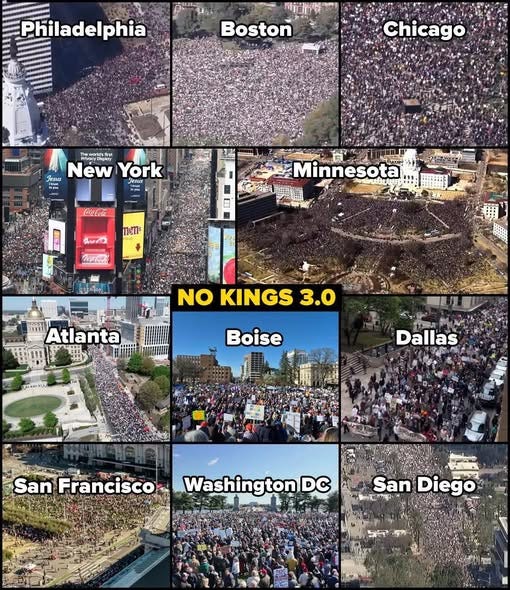
CBS had access to this. They had the aerial footage. They had the full scope of 3,300 protests across the planet. They had photographers in every major city. They made a choice about what to show you, what word to use, and how many seconds it deserved — and they made that choice in advance, with full knowledge of what March 28th was going to be.
What followed was a twelve-minute piece about a woman who survived 903 days of captivity and came home in September. It is a true story. A story that deserved to be told — and had six months of mornings to be told on. It is also a story in which the Trump administration’s role is one of rescue and success. CBS chose this one. On this morning.
That is not a coincidence. That is not deadline pressure. That is a decision made in advance by people who knew exactly what March 28th was going to be.
I’ve been sitting with Gil Scott-Heron all morning. The Revolution Will Not Be Televised — people have been quoting that song for fifty years without quite sitting with what he was actually saying. He wasn’t lamenting the media. He was declaring where power lives. The revolution is not a broadcast. It doesn’t happen to you while you watch. It happens in bodies, in streets, in the choice to show up. Television was never going to be the point.
What’s new is this: we now understand that television is also not the record.
Media is the first draft of history. We say it like it’s just a phrase, but it’s true in the most literal way — future historians, future organizers, future kids trying to understand what their parents’ generation was living through will go looking for what happened yesterday. And they will find what we leave for them.
Right now, the first draft reads: thousands.
We were there. We know what thousands looks like. March 28th was not that.
You were there yesterday, in some form — in the streets, watching a livestream, tracking the numbers, feeling the thing that millions of people felt at the same time. Write it down. Not a reaction. A record. What city. What the crowd looked like when it stretched beyond what your eyes could hold. What someone near you said. What it felt like to be one body in a sea of millions who decided this day mattered. Tell your story.
Post it. Put your name on it. Date it. Put it somewhere it can be found.
We are the archive. We always have been — every letter saved in an attic, every diary entry, every photograph passed down because someone thought this happened and someone should know. That instinct is older than journalism. It belongs to us.
The revolution will not be televised.
So, we are the ones writing the first draft now.
Start today. The record is waiting for what you know.
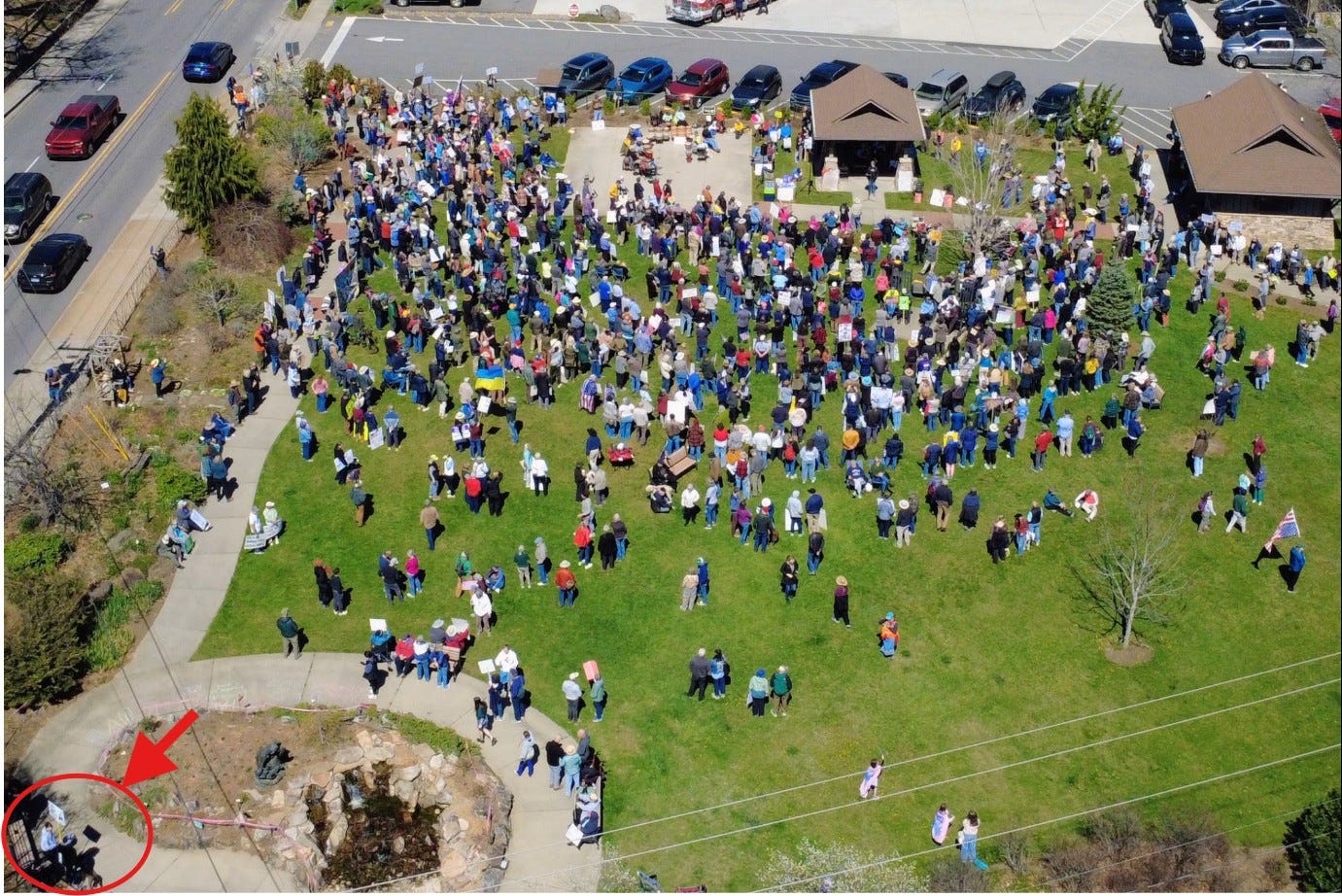
Mine begins in Black Mountain, North Carolina — about 1,800 friends and neighbors gathered in the town square. The best line I heard all day came from somewhere in the crowd: “If Kamala were president, we’d all be having brunch right now.” We laughed. We lined the streets and moved to the beat of the drummers on the hill. It was a beautiful, sunny, chilly day.
Democracy Spark provides ghostwriting for grassroots democracy organizations. You have the passion and vision, I have the words that move people to action. Let’s collaborate to bring our democracy back for the next generation.
Sunday is the last show I watch on CBS. I too thought their lack of reporting of this historic event was bull shit.
I totally missed the erroneous sign. Thanks for pointing it out. I started noticing a slight shift in the show two weeks ago, and it is particularly noticeable in their matter-of-fact coverage of the war in Iran, without a hint of negativity, much like their approach to No Kings protests. I’ve been a regular follower of the show for the past few years, but I don’t know how much longer that will continue.