
I love dog videos. They are my happy place on Facebook. Dogs wearing pajamas. Dogs deeply offended by vegetables. Dogs refusing to come inside because it is snowing. Dogs with jobs they are spectacularly unqualified to perform. I will stop scrolling for almost any dog doing almost anything.
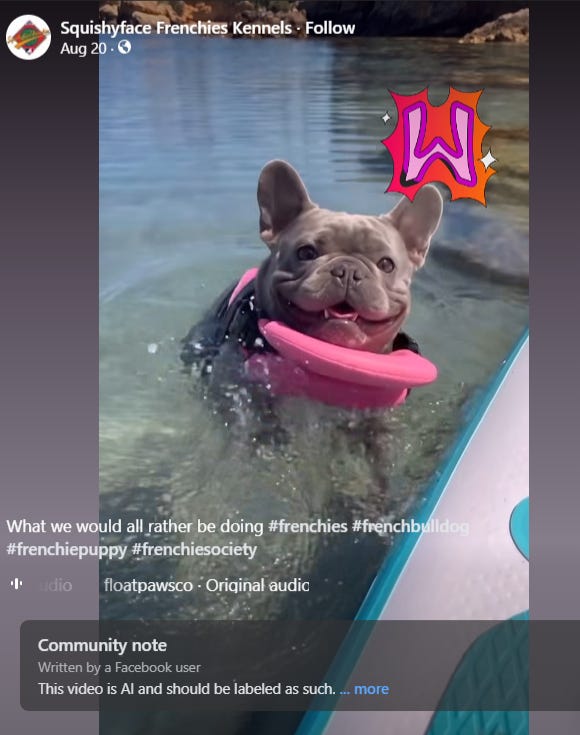
A few days ago, I found a French bulldog floating in a swimming pool wearing a pink life preserver with a little chin rest. He was just hanging there, completely content with his circumstances, until someone called his name. His ears popped up, he smiled, and he started paddling toward them.
I shared it with the words, “This brings me such joy.”
Sometime later, a box appeared beneath the video.
Community note
This video is AI and should be labeled as such.
Well, okay.
I didn’t particularly care whether the Frenchie was real. I hadn’t shared the video as evidence of anything. Nobody was asking me to invest in his swimming school. He made me happy. That was the entire transaction.
But I had never seen a Community Note before, so I clicked. Facebook explained that a user in the Community Notes program had written the note and that other contributors had rated it helpful. I clicked again. Contributors, I learned, write notes on posts they believe may be misleading. A note appears when contributors with different viewpoints agree that it is helpful.
Then Facebook invited me to join the waitlist.
It took me a minute to realize what I had stumbled into. Facebook has an HOA now.
Somebody in the neighborhood saw this French bulldog and decided he was out of compliance. They wrote him up. The committee agreed. A notice appeared on the property.
I kept scrolling, and before long I encountered a goldendoodle sitting behind a news desk. He was wearing a brown necktie and speaking with a British accent. His program was called The Evening Sniff.
No Community Note.
This is the essential experience of an HOA. Your garbage cans are visible four minutes after the permitted time while three houses down somebody appears to be constructing an airport hangar.
I laughed. Then I started wondering who these people were and what, exactly, Facebook had empowered them to do. That was when the joke changed.
In 2025, Meta ended its third-party fact-checking program in the United States and replaced it with Community Notes.
I had just watched the replacement at work.
Meta replaced fact-checking with something that doesn’t confirm facts.
Community Notes may provide useful information. Contributors can offer sources, correct misleading claims or point out something the rest of us missed. But the process Meta describes is not verification. It establishes that enough people found a note helpful, not that someone established the underlying concern as fact.
That would be an interesting little story about Facebook if it weren’t August 2026.
We are less than three months from the midterm elections, and the propaganda isn’t coming. It is already here. Political misinformation, manufactured outrage and deliberate attempts to deepen the divisions between Americans move through our information environment every day. Foreign governments have spent years learning where those divisions are and how to press on them. Domestic actors know how to do it too. The volume and intensity will grow as November approaches.
Meta still has professional systems that investigate coordinated foreign influence operations, voter interference and other serious violations. Community Notes didn’t replace those systems. It replaced professional fact-checking.
There is another thing I have come to understand.
When I sit down to read the news, I am settled in with my coffee and my tablet. I read The Atlantic and the BBC and Stars and Stripes and The New York Times, focused on the stories and what they mean for our world. I come there for news. I deliberately turn my attention toward understanding what is happening.
When I sit down with Facebook to consume my dog videos, I am doing something entirely different. What I hadn’t appreciated was what I was subjecting my brain to along the way. I am focused on a particular kind of content, so I don’t necessarily pause on the things that aren’t the entertainment I came for. That doesn’t mean I don’t see them. Headlines register. Images flash past. Bits of information slip through. And when I do stop to consume something consequential, I encounter it in the same mental environment where, seconds earlier, I was watching a dog float around a swimming pool.
Here is what a few minutes scrolling through Facebook can look like:
French bulldog in a pool.
Best friend’s picture from Spain.
Advertisement for a smoothie blender.
New funny dance that looks like the way a monkey swings.
3,800 people infected with measles in a detention center.
Recipe for banana bread.
Neighbor has a new granddaughter.
Navy sailors’ mental health decline leading to a suicide surge.
Goldendoodle anchoring The Evening Sniff.
Armed ICE agents now have stun-gun gloves.
Springer spaniel snuggled up against Dad because of thunder.
Did you feel it too? There is no time for the mind to settle into the kind of attention consequential information deserves. Entertainment has disarmed us, and then the serious thing slips past the critical-thinking guard before the next thing arrives.
And this is the information environment in which Facebook replaced professional fact-checking with an HOA.
One of the publications on my tablet every morning is Stars and Stripes. I am a military daughter and have spent my life as part of a military family. When people we love are serving around the globe, it is one of the places we go to understand what is happening around them.
Stars and Stripes is editorially independent from the Pentagon. That independence isn’t a tradition maintained at the Pentagon’s discretion. Federal law requires it. The paper’s journalists are free to report on the military and the government, including reporting that makes the people running either one uncomfortable.
Yesterday, the Pentagon moved to fire Stars and Stripes’ editor-in-chief, publisher and one of its reporters. Both Editor-in-Chief Erik Slavin and reporter Lara Korte said their separation notices cited interviews they gave to CBS. Slavin had said censorship of news for service members would be a red line. Korte had said she worked for Stars and Stripes, not the Pentagon, an administration or a policymaker.
The Pentagon is asserting authority over people working for a news organization whose editorial independence from the Pentagon is protected by law. That looks like an extraordinary overreach. Whether it is illegal is a question for the courts.
That happened while Facebook was teaching me about its HOA.
Hard-hitting, accurate journalism requires reporters to interview people, examine documents, cultivate sources, check claims, provide context and sometimes make themselves profoundly inconvenient to powerful institutions. That work requires time, expertise, resources and independence.
Meanwhile, social media remains largely unfettered. Journalism, propaganda, advertising, opinion, friendship, entertainment and synthetic French bulldogs travel through the same feed. Meta removed professional fact-checkers from that environment and replaced them with users deciding whether another user’s note is helpful.
I am still going to Facebook for the dogs. The French bulldog can stay, whether he ever existed or not. So can the goldendoodle delivering The Evening Sniff. I will happily admire your granddaughter, look at your pictures from Spain, ignore the smoothie blender and probably watch the monkey dance twice.
But when I want to know what is happening in my country and my world, I can make that a deliberate act. I can settle in with my coffee, open the work of journalists who have interviewed the sources, read the documents, asked the uncomfortable questions and done the work to establish the facts. I can give that reporting my focused attention, and I can support the people doing it so they remain independent enough to keep doing their jobs.
As November approaches, that distinction matters.
I would like to leave you with this: Facebook has the dogs. Journalists have done the professional reporting. Numb scrolling blurs meanings that deserve to remain distinct. Read with intention.

Have you ever mused, “I’m just going to leave the country”?
Well, I am now in the middle of that great adventure. Turns out leaving is not what you think it is. It’s complicated, it’s hard, often exciting, frequently overwhelming, and it’s a lot more interesting than the daydream.
If you’re curious, or if your own musing might someday become a real plan, come follow along on my new blog, So She Left
Democracy Spark provides ghostwriting for grassroots democracy organizations. You have the passion and vision, I have the words that move people to action. Let’s collaborate to bring our democracy back for the next generation.
Excellent, on point perspective as always. One of my favorite posts of yours, and among all Ive read this week. 👏👏